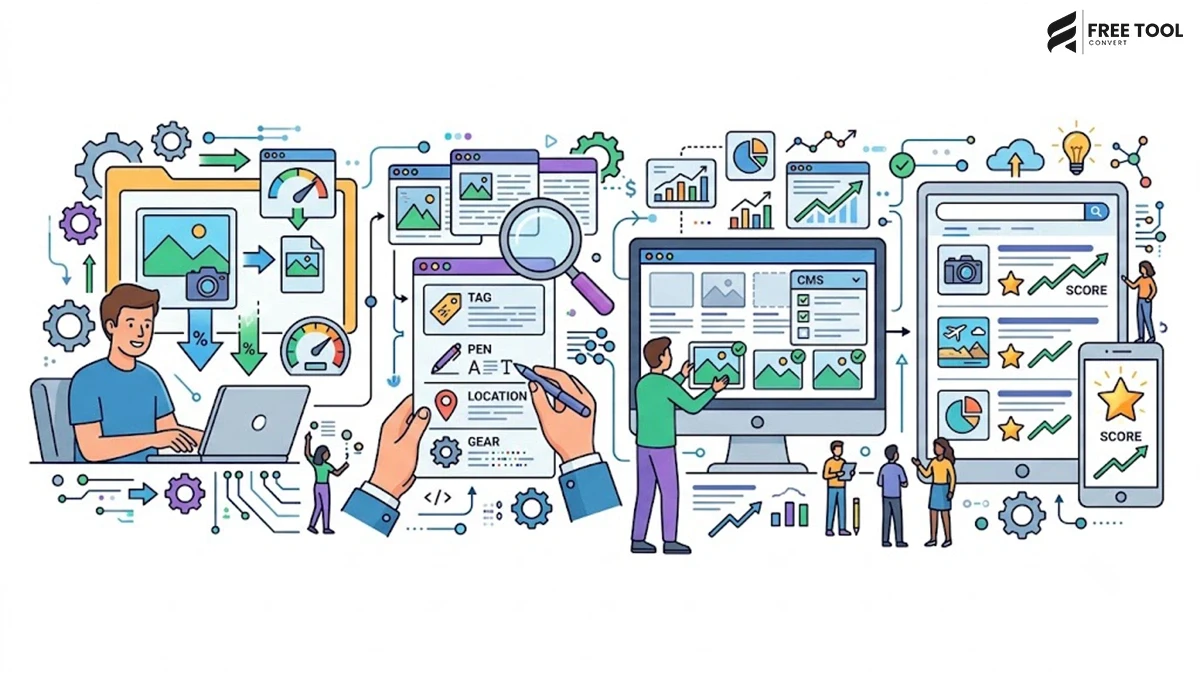
iPhone HEIC Photos to JPG: Convert Them or Change Your Camera Settings
In this article
iPhones save photos as HEIC by default. It is an efficient format — similar quality at roughly half the size of JPG — but Windows PCs, many government and job portals, and older apps still won’t accept it. You can fix this in two ways: convert the HEIC files you already have, or change your iPhone so new photos are easier to share. This guide covers both.
Option 1: Convert HEIC photos you already have
The quickest way is the free HEIC to JPG converter, which works on any device, including Windows PCs and Android phones:
- Open the HEIC to JPG converter.
- Add up to 20 HEIC or HEIF photos at once (up to 30 MB each).
- Choose JPG (smaller, accepted everywhere) or PNG (lossless, larger), and a quality. JPG at 90% is a good default.
- Convert, then download the photos individually or as a ZIP.
The conversion happens in your browser. Your photos are not uploaded, which matters for personal pictures and photos of documents. Decoding HEIC takes a few seconds per photo, especially on older phones.
Converted photos don’t keep EXIF metadata such as GPS location — usually a plus when you share them.
Option 2: Make your iPhone save JPG instead
If you regularly upload photos to portals or send them to Windows users, you can switch the camera format:
- Open Settings → Camera → Formats.
- Choose Most Compatible.
New photos are then saved as JPG. The trade-off is file size: JPG photos take up noticeably more storage than HEIC. Photos you have already taken stay in HEIC.
Option 3: Let the iPhone convert when transferring
Keep HEIC on the phone, but get JPG on your computer:
- Open Settings → Photos.
- Under Transfer to Mac or PC, choose Automatic.
When you copy photos to a computer with a cable, the iPhone converts them to a compatible format. Sharing through many apps — Mail, for example — also converts automatically. AirDrop to a Mac keeps HEIC, since Macs open it natively.
Opening HEIC directly on Windows
Windows 10 and 11 can display HEIC after installing Microsoft’s HEIF Image Extensions from the Microsoft Store (some PCs also need the HEVC Video Extensions). That lets you view HEIC files, but websites and portals still won’t accept them for upload — for that, convert to JPG.
JPG or PNG?
- JPG for almost everything: uploads, WhatsApp, email, printing. Small and universally accepted.
- PNG if you will edit the image heavily and want no further compression loss. Expect files several times larger.
Next steps after converting
- Compress the JPG to meet an upload limit — see compressing an image below 50 KB.
- Resize it to exact pixel dimensions.
- Combine photos into a PDF for document submissions.
- Make a passport-size photo from it.
For more on the formats themselves, read HEIC vs JPG explained.