
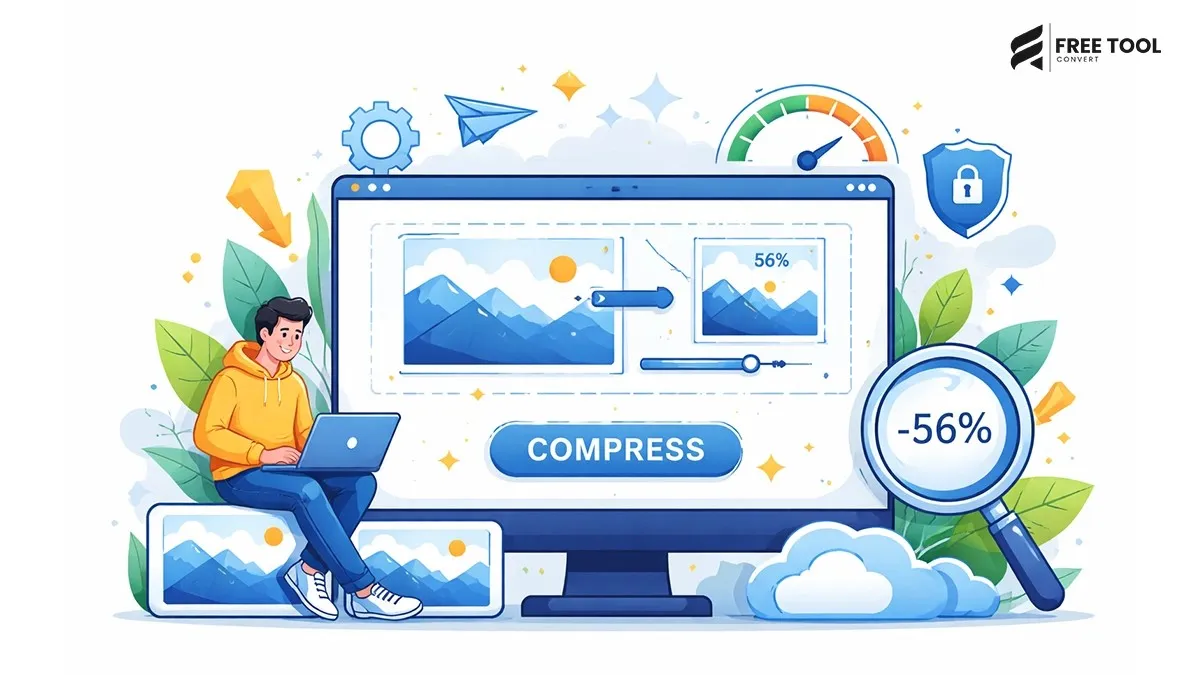
Introduction: Why Image Compressor Online Is Essential in 2026
Images are responsible for 90% of the user experience in any modern digital asset. This includes web pages, eCommerce sites, blogs, mobile apps, social networks, and online portfolios; pictures are what provide that touch of sparkle. The problem is they also have a negative impact on Internet speed, visitors’ experience, and server performance.
That‘s when an image compressor becomes an essential tool.
A professional online image compressor is capable of reducing the size of an image file without a visible loss in quality. Whether you‘re compressing JPG, PNG, WebP, or other types of images, an image compression tool optimized with the highest quality compression technologies will provide increased loading time and speed.
Table of Contents
What do I mean by image compressor?
An image compressor is a program that will lower the size of image files while keeping the image visually acceptable. In order to do this, it will attempt to compress the image by removing unwanted data, compress the data within the pixels, and change the way the file is stored.
A good image compression tool allows you to:
- Compress JPG images
- Compress PNG images
- Compress WebP files
- Decreased the size of an image to make it more suitable for the web.
- Good image quality upper limits
- It is important if you want to make the most out of your capability on the DVD to keep a high image quality.
- Improve page speed
- Download optimized images with a single click
Many of today‘s most popular tools now work seamlessly within your browser.
Why Image Compression Matters
Here‘s why compressing images is crucial:
1. Faster Website Loading Speed
Large images significantly affect the performance of any site. The size of the pages is directly related to the images shown on the site. Compressed images can vastly reduce the weight of a page and speed up the page load time.
2. Better SEO Rankings
Google prefers websites that load quickly.
3. Improved User Experience
Persistent pages! Users give up on pages that take too long to load.
4. Reduced Hosting Costs
Smaller files save bandwidth and server space.
5. Enhanced Mobile Performance
Compressed images load faster on mobiles.
How Image Compression Works
Image compression: It is designed to reduce image size using various algorithms.
There are two primary types:
Lossy Compression
Lossy compression is a compression that sacrifices image data to produce smaller file size.
Benefits:
- Smaller file sizes
- Quick load time
Drawback:
- Slight quality reduction
- The process of JPG uses lossy compression.
Lossless Compression
Lossless compression does not discard any data but instead minimizes the file size.
Benefits:
- Neither quality decreases.
- Perfect for logos and graphics.
Drawback:
- An order of magnitude larger file than lossy compression
- Typically, PNG compression is lossless.
Lossy or Lossless: Which Should You Choose?
| Feature | Lossy | Lossless |
| File Size | Smaller | Larger |
| Quality | Slightly reduced | Preserved |
| Best For | Websites & photos | Logos & graphics |
| Speed | Faster loading | Moderate |
Most websites use lossy compression for performance optimization.
How to Compress Images Online (Step-by-Step Guide)
Using an online image compressor is simple:
Step 1: Upload Your Image
Click or tap to drag and drop your file. Or drop your JPG, PNG, or WebP.
Step 2: Choose Compression Level
Choose low, medium, or high compression.
Step 3: Compress
Click the compress button.
Step 4: Download Optimized Image
Download the compressed image immediately.
No installation has to be carried out.
Supported Formats in Image Compression
A professional image compressor should support:
- JPG compression
- JPEG compression
- PNG compression
- WebP compression
- GIF compression
- HEIC compression
Multi-format support ensures flexibility.
Image Compression for Website Owners
Website owners compress images to:
- Make the homepage faster.
- Optimize blog articles
- Speed up product pages
- Increase the number of landing pages for each logical cluster.
- Reduce server load.
Optimizing images is one of the key areas in improving web performance.
Image Compression for eCommerce Stores
All eCommerce sites are image-based.
- Compressing product images helps:
- Increased shopping cart and checkout page speed
- Higher Google ranking
- Improved mobile performance
- Lower hosting cost
- Higher conversion rate
Very product-centric websites are likely to be the greatest winners.
Image Compression for Bloggers
Bloggers frequently post large-resolution pictures.
Using an image compressor helps:
- Cut back the size of the blog page
- Improve AdSense performance
- Increase organic traffic and pick up the visibility in search. When search engines pay thousands of dollars on paid search marketing and link building, organic search strategy always leads the way.
- Lower hosting bandwidth
- Online and offline modulation.
Images optimized will benefit the blog in the following ways
Image Compression for Social Media
Social media platforms compress images automatically, but starting with optimized files:
- Fosters clearer understanding.
- Decreases upload time
- Keeps visual quality
- Ensures brand consistency
Compressed images load on mobile, desktop, etc.
Does Image Compression Reduce Quality?
Yes. Narrowly, in the correct way. Yes, charitably, in the correct way.
Modern compression algorithms:
- Accuracy of vision is maintained
- Remove clutter metadata.
- Optimize the way pixels are encoded
- Maintain color fidelity.
Quality reduction is something only noticed if the balancing of compression is not properly taken into account.
Best Practices for Image Compression
Follow these expert tips:
- Select the optimum file format (JPG for the photographs, PNG for the graphics).
- It‘s double compression to keep reminding each other.
- Compress prior to upload to the website.
- Opt for WebP. If available, this format is recommended.
- Verify image size.
- Remove any unnecessary information or metadata.
- Test page speed after optimization.
Common Mistakes During Image Compression
- Overcompressing (more quality loss than necessary)
- Applying further compression to already compressed images
- Neglect of formatting options
- Uploading dimension larger than standard size
- Should not test page speed enhancement
Proper compression is a delicate balance.
Image Compressor vs Image Resizer
| Image Compressor | Image Resizer |
| Reduces file size | Changes dimensions |
| Maintains size | Maintains quality |
| Improves speed | Adjusts layout |
| SEO benefit | Design benefit |
Using both together gives the best results.
Security in Online Image Compression
Choose tools that:
- Use HTTPS encryption
- Auto-delete files.
- Do not save the data.
- Should be able to process data files in the cloud securely.
Data protection should be at the forefront of everything.
Advanced Features in Modern Image Compressors
Modern tools offer:
- Batch compression
- Quality slider (so far unadjustable)
- Drag-and-drop user interface
- WebP transition
- Webcam preview in real, time
- Comparison of the size, before and after
- Optimization using artificial intelligence
- Cloud processing,
More sophisticated compression programs improve efficiency.
Mobile Image Compression
Modern compressors allow:
- Reduce photo size from mobile album
- Instant download.
- Share through WhatsApp/email directly
- Optimize images before uploading
Mobile optimization is more convenient.
Core Web Vitals and Image Compression
Optimized images improve:
- Largest Contentful Paint (LCP)
- Cumulative Layout Shift (CLS)
- First Input Delay (FID indirectly)
Better Core Web Vitals = better ranking potential.
The Future of Image Compression
With AI and machine learning, future image compression tools will:
- Select auto-detect best format
- Dynamically optimize.
- Integrate with CDN
- Offer intelligent resize
- Provide adaptive compression.
Optimizing the images will become fully automated.
Conclusion
Image Compressor. If you work with digital media at all, this one is a no-brainer. Bloggers, web designers, eCommerce sellers, marketers, and business owners—compression makes everything faster, better for Search Engine Optimization (SEO), and more usable.
Large images impact page load times, rankings, and conversions. Using a dedicated online image compressor will minimize file size but preserve the visual quality.
Whether you‘re directly optimizing your webpage‘s PageSpeed score, increasing mobile performance, or even cutting costs on hosting, we’re all searching for processes that can deliver a powerful impact with minimal effort on our part. Why not optimize an entire site by simply optimizing images?
If you care about faster websites, better SEO, and a better user experience, you should start compressing your images today.
Frequently Asked Questions (FAQs)
1. What is the best format for image compression?
JPG is best for photographs. PNG is best for non‑photographic images. WebP is best used for optimizing the performance of websites.
2. Does compressing images hurt SEO?
No, it is SEO-friendly by increasing website loading speed.
3. Can I compress multiple images at once?
Yes, batch compression is now supported in many tools.
4. Is image compression free?
Numerous online tools use these to do free unlimited compression.
5. Does compression reduce quality?
Too much quality loss if done improperly.
6. How much can compression reduce file size?
The position of the lesion due to the potential for spillage of uninvolved tissue is generally 20 to 70%. Compress Images Instantly
Are you prepared to enhance your images?
Upload your JPG, PNG, and WebP files now. Compensate for reduction in quality due to text compression by reducing the size of the file.
Instantly improve website speed and SEO.
Security: Descargar images optimizadas free.
So go on, get to Image Compressor now and work smarter, not harder.